PYPI PACKAGE AUDIT
v0.1.0
Healthy Package
studyrag
A private, offline study assistant: grounded Q&A with citations over your own slides, PDFs and notes (OCR included).

685
/ 1000
Quick Install
pip install studyrag
1. Governance
50/200
2. PEP Metadata
200/200
3. Security
150/200
4. Docs & SEO
155/200
5. CI Engineering
130/200
📣 Share Audit:
Share this report and visual preview in the current language
PYPI TELEMETRY
Downloads & Community Adoption
Last 30 days (without mirrors)
Last 7 days
107
Last 30 days
107
Total (180 days)
107
Health & Engineering Analysis (5 Pillars)
1. Governance & Community50 / 200 ▾
LICENSE✓ 50 pts
SECURITY.md✕ 0 pts
CONTRIBUTING.md✕ 0 pts
CODE_OF_CONDUCT.md✕ 0 pts
2. PEP Metadata & Packaging200 / 200 ▾
Wheel (.whl)✓ 50 pts
pyproject.toml✓ 50 pts
Project URLs✓ 50 pts
Trove Classifiers✓ 50 pts
3. Security & Supply Chain150 / 200 ▾
Zero CVEs (OSV)✓ 60 pts
Trusted Publishing (OIDC)✕ 0 pts
Snyk / Audit Link✓ 40 pts
HTTPS Repository✓ 50 pts
4. Documentation, SEO & Ecosystem155 / 200 ▾
Structured README✓ 60 pts
Read the Docs✓ 50 pts
Django Packages✕ 0 pts
Website / Technical Articles✓ 45 pts
5. Engineering, CI & Quality130 / 200 ▾
Automated Tests✓ 65 pts
GitHub Actions CI✓ 65 pts
CHANGELOG.md✕ 0 pts
Env & Lockfile (uv/rye/poetry/pdm/hatch)✕ 0 pts
README & DOCS
PyPI Metadata v0.1.0
Official Documentation & Usage Guide — studyrag
Show full original documentation (English README) ▾
StudyRAG
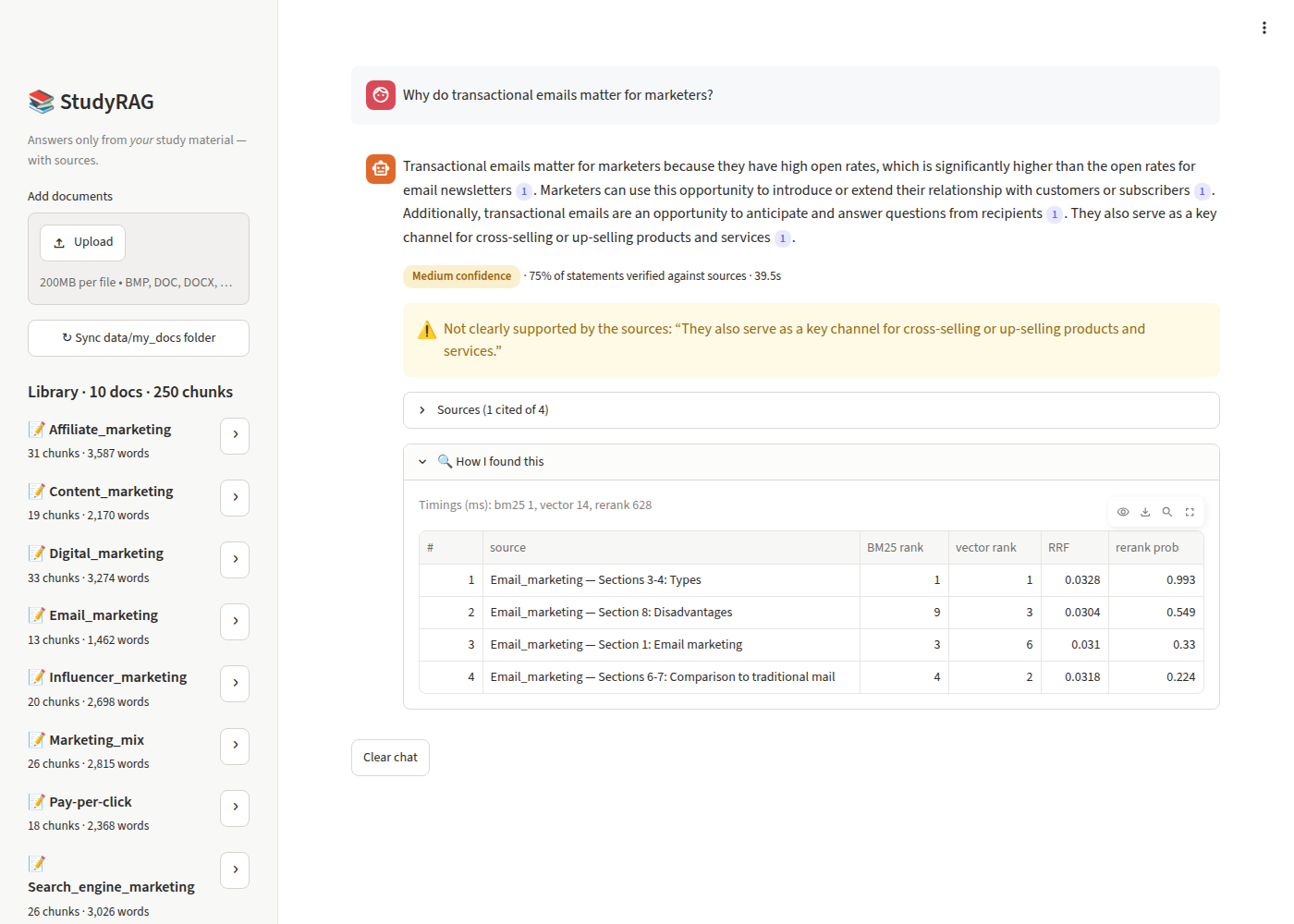
A private study assistant that answers only from your own course material (slides, PDFs, Word files, notes, even image-only slides through OCR), with a citation to the exact slide or page, and says "not in your documents" when the answer isn't there. Everything runs on a CPU; no GPU needed.
pip install studyrag                      # search, citations, OCR, CLI (models download on first use)
pip install "studyrag[local-llm]"         # + local LLM answers via llama.cpp (compiles; see the setup guide)

studyrag sync ~/my-lecture-notes          # index a folder (data lives in ~/.studyrag; STUDYRAG_HOME to change)
studyrag search "porter five forces"      # ranked, cited passages
studyrag ask "What is a market space?"    # needs a local model or an OpenAI-compatible API (STUDYRAG_LLM_BACKEND=openai)
Built from scratch: BM25, vector search, Reciprocal Rank Fusion, cross-encoder reranking, a calibrated refusal threshold and a sentence-level answer verifier. Measured on 77 labelled questions: the right passage in the top 3 for 100% of answerable questions, 14/14 unanswerable questions refused.
- Use it from Claude Code, Claude Desktop or Cursor with the MCP server:
studyrag-mcp - Source, Streamlit web app, results and docs: https://github.com/Abubakar-idrees-01/data-to-impact/tree/main/01-rag-from-scratch